The Djibouti Agency for Social Development (ADDS) is intensifying its efforts to promote the economic integration of young people in Obock. Through an awareness-raising meeting organized as part of the Integrated Community Resilience Project (PIRC), the institution mobilized a large segment of local youth around opportunities for entrepreneurship, financing, and interregional development, thus outlining the contours of a more inclusive and resilient economic future.
As part of the national effort to promote employment and community resilience, the Obock region hosted an important meeting dedicated to youth entrepreneurship on Tuesday afternoon. Organized by the Djiboutian Agency for Social Development (ADDS), this awareness-raising meeting was part of the Integrated Community Resilience Project (PIRC), a structuring program aimed at strengthening local economic capacities.
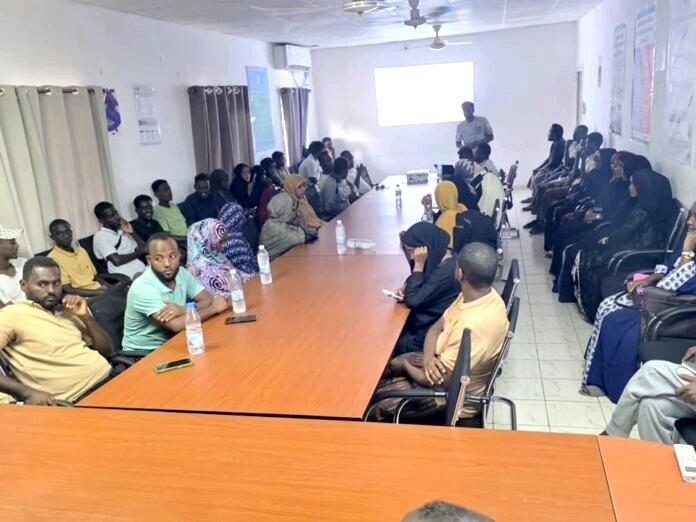
This strategic meeting, chaired by the Director General of ADDS, Mahdi Mohamed Djama, took place at the Obock Regional Council headquarters. Several agency officials were also present, including the Director of Financing, the PIRC Project Coordinator, and the Entrepreneurship Program Manager. The Vice-President of the Obock Regional Council also attended, demonstrating the local authorities’ commitment to this major initiative.
Facing them was a large and attentive group of young people from Obock, who had come not only to learn and better understand the issues, but above all to seize the opportunities offered by this ambitious project.
The objective of this meeting was to raise their awareness of the importance of entrepreneurship as a real lever for economic and social development, while highlighting the support systems and financing mechanisms that can transform their initiatives into concrete and viable projects.
It is worth noting that PIRC, with a total portfolio of $31 million and co-managed with the Ministry of Social Affairs and Solidarity, aims to be a structuring tool for the regions. For Obock in particular, it plans to create or strengthen 50 very small and medium-sized enterprises (VSMEs), as well as establish or support 10 mutual aid groups based on shared interests (GEAs). These figures reflect a clear commitment to sustainably anchoring economic activity at the local level.
In his address, the Director General of ADDS, Mahdi Mohamed Djama, delivered a message that was both inspiring and pragmatic. He encouraged young people to fully exploit the strategic potential of their region, particularly in cross-border trade. Located near several regional trade routes, Obock possesses undeniable geographical advantages that young people are urged to capitalize on. He emphasized the importance of cultivating an entrepreneurial spirit based on innovation, initiative, and the use of local resources. “Obock’s economic future depends on your ability to transform opportunities into concrete projects,” he stated, essentially calling on young people to become agents of change.
The ensuing discussions highlighted several promising sectors with the potential to generate employment and added value in the region. These include smart agriculture, cultural and creative industries, fishing and fish processing, food processing, and other emerging sectors adapted to local realities. The PIRC intends to invest in all these areas to stimulate the regional economy.
Beyond the local dimension, the Director General of ADDS also outlined a broader vision focused on developing interregional trade. He specifically mentioned the possibility for young people in Obock to become involved in trade networks linking Yemen, Tadjourah, Djibouti City, and Ethiopia. This approach aims to strengthen economic synergies between regions and create new business opportunities.
In this context, he encouraged facilitating the transport of Yemeni products to other national and regional markets, while also inviting traders from Tadjourah to sell their Ethiopian imports in Obock. This dynamic of cross-border trade could, in the long term, contribute to boosting the entire regional economy.
The meeting was distinguished by its interactive and participatory nature. The young people present did not hesitate to ask questions, share their concerns and express their expectations.
For their part, ADDS officials provided detailed answers, thereby strengthening the understanding of the proposed systems and generating real enthusiasm.
At the end of this meeting, one thing is certain: the youth of Obock are ready to embark on the path of entrepreneurship, provided they receive adequate support. Through the PIRC, ADDS seems to have laid the foundations for an ecosystem conducive to the emergence of local initiatives that foster growth and resilience.
By mobilizing young people around concrete projects and facilitating access to financing, the Djibouti Agency for Social Development reaffirms its central role in implementing the country’s social and economic policies. More than just a program, the PIRC thus emerges as a true catalyst for transformation, placing youth at the heart of sustainable territorial development.
In Obock, this ambition is now taking shape, driven by a new generation of entrepreneurs determined to build the future.