


A ceremony to award certificates and driver’s licenses to some 32 young people who had completed vocational training was held last Tuesday morning in Damerjog. Organized by the Djiboutian Agency for Social Development (ADDS) in collaboration with the Ministry of National Education and Vocational Training, the event is part of the Ministry of Social Affairs and Solidarity’s Emergency Social Protection and Food Crisis Response Project, funded by the World Bank.
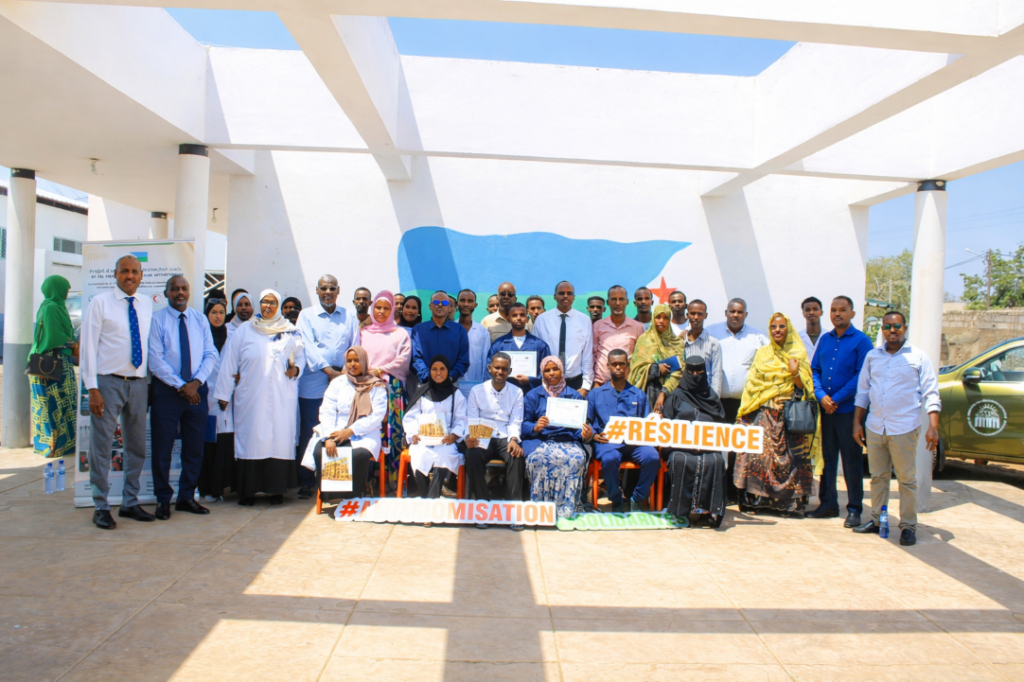
A festive atmosphere reigned on Tuesday morning at the Damerjog vocational training center in the Arta region. In a carefully arranged room, families, local authorities, institutional leaders and young beneficiaries shared this hopeful moment.
The event was anything but ordinary. It marked the culmination of four months of intensive training for 32 young people from the sub-prefecture, now holders of professional certificates or driving licenses, precious keys to a long-awaited socio-professional integration.
In addition to the beneficiaries, the ceremony dedicated to this event took place in the presence of the prefect of the Arta region, Hassan Dabaleh Ahmed, the sub-prefect of Damerjog, Mouna Farah Iyeh, the director general of the Djiboutian Agency for Social Development (ADDS), Mahdi Mohamed Djama, the director general of Vocational Training at MENFOP, Mohamed Abdi Guedi, the director of the Social Development department of ADDS, Galab Hassan Galab, as well as local elected officials, center officials, a representative of the regional council of the sector and numerous local personalities.
The atmosphere was filled with solemnity but also emotion. For behind each certificate presented lies a story of perseverance, of difficulties overcome and of hope regained.
Organized by the Djiboutian Agency for Social Development (ADDS) in collaboration with the Ministry of National Education and Vocational Training (MENFOP), this initiative is part of the Ministry of Social Affairs and Solidarity’s Emergency Social Protection and Food Crisis Response Project, funded by the World Bank. Its objective is to provide the most vulnerable populations with concrete tools to sustainably improve their living conditions.
In a locality like Damerjog, where employment opportunities remain limited for young people, especially women, vocational training represents much more than simple technical learning. It becomes a lever for social dignity, financial independence, and family stability.
Electricity, computer science, and driving instruction—the chosen fields of study meet the real needs of the local and regional market. Indeed, in addition to the numerous buildings at the entrance to the town, Damerjog is home to the country’s industrial free zone. This approach aims precisely to align training with existing job opportunities in this sector across the country.
Strong commitments from local authorities
In his address at the event, Mohamed Abdi Guedi, Director General of Vocational Training at the Ministry of National Education and Vocational Training (MENFOP), noted that these training programs, conducted jointly by the ADDS (National Agency for Social Development) and his ministry, are part of a broader initiative launched by the highest authorities in the country to strengthen young people’s technical skills and improve their employability. “It’s true that these were short, targeted, modular training programs, but they address a need in the job market,” he emphasized, expressing his hope that these skills would enable the participants to find employment. He also commended the ongoing collaboration with the ADDS and encouraged the young people to consider not only employment in local businesses but also entrepreneurship: “You can be your own boss and start your own business.” According to him, the essential objective remains to provide them with “skills that will allow you to be financially independent,” before congratulating the participants for their diligence and perseverance, reminding them that “a long journey begins from this moment.”
For his part, the prefect of Arta, Hassan Dabaleh Ahmed, welcomed an initiative that directly addresses the daily concerns of the population.
He stressed the need to expand this type of program in order to sustainably combat youth unemployment, which is often a source of social vulnerability.
“Investing in youth is investing in social peace and in the future of our country. When our young people acquire skills, they become a productive force for the entire nation,” he said.
Speaking in turn, Galab Hassan Galab, Director of the Social Development Department at ADDS and the main organizer of the ceremony, indicated that this initiative falls within the framework of the Emergency Social Protection and Food Crisis Response Project, which aims to provide vocational training to 400 young adults from the interior regions. He emphasized that the primary objective is to equip young people with technical skills adapted to local needs and the demands of the job market. “The Djibouti Agency for Social Development’s fundamental mission is to promote the empowerment of the most vulnerable populations, particularly Djiboutian youth,” he stated, stressing a long-term vision where “every young person has the necessary skills to integrate with dignity into working life.” According to him, the project carried out in Damerjog perfectly illustrates this commitment by enabling 32 young people to acquire concrete skills in electricity and computer science, as well as obtain driver’s licenses.
Addressing the beneficiaries directly, Galab Hassan Galab commended their courage and perseverance: “Through your perseverance and determination, you have proven that every obstacle can be overcome.” He reminded them that “these certificates are just the starting point of a promising journey” and that this training provides “a solid foundation” for building a sustainable and fulfilling career. He also expressed ADDS’s gratitude to the World Bank for its crucial financial support, as well as to the Ministry of National Education and Vocational Training (MENFOP) for the quality of the technical training provided. Finally, he thanked the ADDS technical team, the regional council, and the prefecture for their ongoing support, emphasizing that social development requires collective mobilization and that “no one should be left behind.”
An event filled with hope
Among the recipients, some faces particularly stood out. That of Intisar Mohamed Ahmed, a discreet but determined young woman, was one of them. After several months of training in the field of electricity, she received her certificate with barely concealed emotion. In a sector still largely dominated by men, her journey symbolizes significant progress.
Alongside him, Neima Idriss Farah, a certified computer scientist, shares the same ambition. Smiling, but aware of the realities of the job market, she sees this training as a crucial first step.
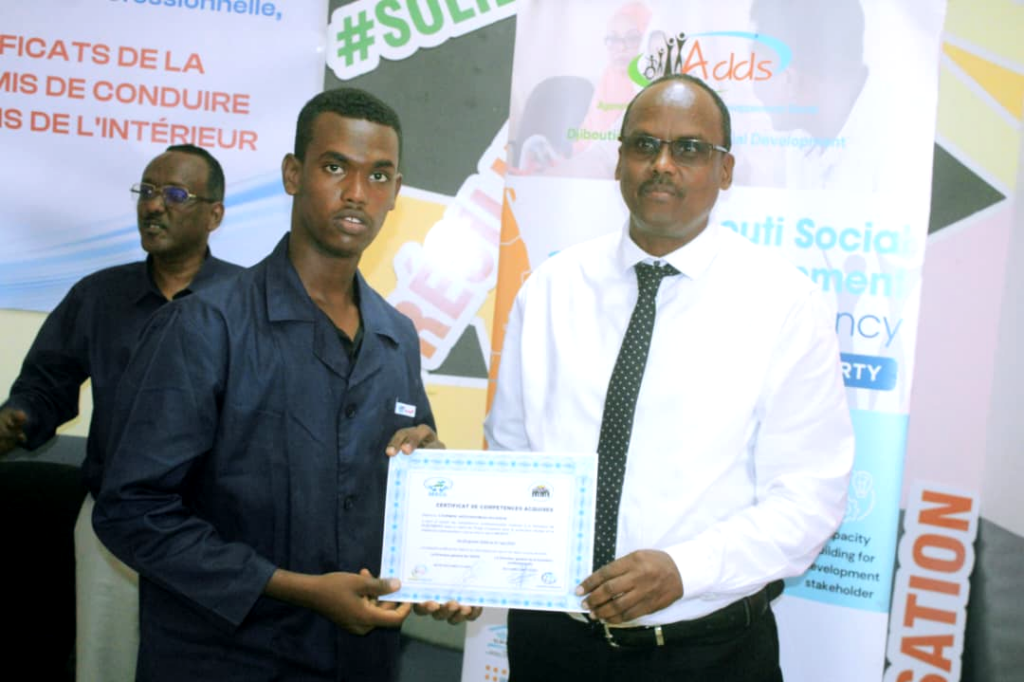
Galado Mohamed Meigag, for her part, received her category B driving licence. An achievement that may seem simple on the surface, but which represents a real turning point.
In several sectors—transport, logistics, services—a driver’s license provides immediate access to the job market. For him, this qualification opens up new opportunities.
“Having a driver’s license here is a real opportunity. It will allow me to look for work at the Port of Damerjog,” she says with satisfaction.
At the end of the ceremony, the various dignitaries present officially awarded the training completion certificates and driver’s licenses to the recipients. Each presentation was warmly greeted with enthusiastic applause. In the audience, families captured these moments of pride with souvenir photos, while exchanging congratulations and words of encouragement. For many parents, seeing their children on the stage symbolized much more than a simple distinction: it represented the tangible hope of seeing them finally find employment and build a better future.
In a sometimes challenging economic climate, these 32 diverse journeys demonstrate that a well-designed, training-oriented public policy can produce tangible results. Beyond the certificates and permits awarded, these young people have gained renewed confidence. For Intisar, Neima, Galado, and the 29 other beneficiaries, this marked the beginning of a new path toward professional integration, financial independence, and the ability to support their families.