The President of the Republic, His Excellency Mr. Ismaïl Omar Guelleh, officially launched the activities of the 2026 National Solidarity Week (SNS) on Thursday. The event took place during a grand ceremony organized at the People’s Palace by the Ministry of Social Affairs and Solidarity (MASS). Under the theme “Together, let’s celebrate our national solidarity, for a more united and forward-looking society,” the 2026 edition reaffirms the centrality of human capital development, a pillar of Djibouti’s Vision 2035.
It was in the People’s Palace performance hall, magnificently decorated to reflect the importance Djibouti attaches to the fight against poverty, that the launch ceremony for the activities of the National Solidarity Week (SNS) 2026 was held last Thursday morning under the high patronage of the President of the Republic, His Excellency Mr. Ismail Omar Guelleh.
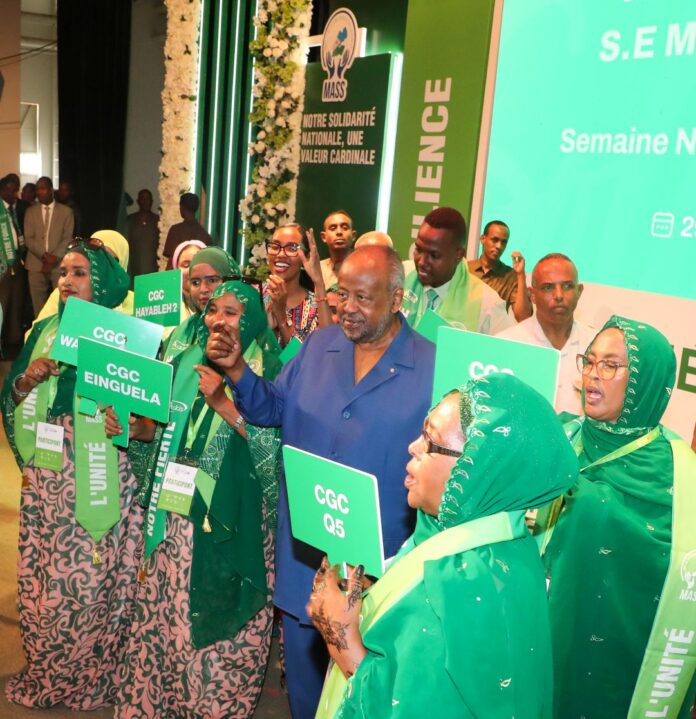
The vibrant and musical event took place in the presence of an impressive array of dignitaries and institutional figures. In addition to the President of the Republic, those in attendance included the First Lady and President of the National Union of Djiboutian Women (UNFD), Her Excellency Mrs. Kadra Mahamoud Haïd; the Prime Minister, His Excellency Mr. Abdoulkader Kamil Mohamed; the President of the National Assembly, His Excellency Mr. Dileita Mohamed Dileita; numerous members of the Government, including Minister Ouloufa Ismail Abdo, the principal organizer of the ceremony; members of Parliament; the prefects of Djibouti City and the interior regions; the presidents of the municipalities and regional councils; officers of the defense and security forces; senior government officials; diplomats from friendly nations; and representatives of technical and financial partners. Alongside them was a diverse crowd drawn from both the three municipalities of Djibouti City and the five interior regions.
This diversity of backgrounds and perspectives reflects the very spirit of National Solidarity Week, which now serves as a forum where the State, technical and financial partners, local authorities, civil society organizations, and community development groups come together around a common goal: to leave no one behind. Under the theme “Together, let’s celebrate our national solidarity, for a more united and forward-looking society,” the 2026 edition aims to further strengthen mechanisms for social protection, economic empowerment, and community resilience.
A ceremony commensurate with the social challenges
After a warm welcome upon his arrival at the Palace esplanade from Prime Minister His Excellency Mr. Abdoulkader Kamil Mohamed, accompanied by the Minister of Social Affairs and Solidarity, Ms. Ouloufa Ismail Abdo, the President of the Republic toured the numerous booths set up in the hall at the entrance to the performance venue. Highlighting the key social projects and programs undertaken by the Ministry of Social Affairs and Solidarity (MASS) and its implementing agency, the Djiboutian Agency for Social Development (ADDS), these exhibition spaces illustrated, with supporting data, the efforts deployed to combat poverty and strengthen community resilience.
Upon entering the hall, the President was greeted by a crowd filled with respect and enthusiasm. The enthusiastic applause reflected the popular support for a social policy resolutely focused on people. The ceremony opened with artistic performances carefully prepared for the occasion. Patriotic songs, folk dances, and skits by the most emblematic artists and troupes of our country punctuated the event, giving solidarity a human face deeply rooted in Djiboutian culture.
A short documentary film highlighting MASS’s achievements over the past year particularly resonated with the audience. Using visuals, it showcased the tangible impact of social programs on the lives of vulnerable households, both in urban and rural areas.
Established in 2008 by the President of the Republic himself, National Solidarity Week is fully aligned with Djibouti Vision 2035, of which strengthening human capital is a major pillar. It also finds its foundation in the National Initiative for Social Development (INDS), launched in January 2007, which laid the groundwork for a structured and inclusive approach within the national poverty reduction program.
Over the years, the SNS has become an essential annual event, allowing not only for the review of social policies implemented, but also for the announcement of new initiatives, the launch of innovative projects and the inauguration of local infrastructure designed to sustainably improve the living conditions of vulnerable populations.
The 2026 edition of the SNS looks promising.
The 2026 edition of National Solidarity Week places particular emphasis on several major strategic areas. Foremost among these is the strengthening of social safety nets, through the continuation of cash transfers to the most vulnerable households, as well as the launch of new targeted programs, notably for orphans with the “Yatim” program.
It also provides for the institutional and financial strengthening of Community Management Committees through the implementation, in collaboration with the UNFD, of the Urban Solidarity program. This program aims to organize, train, and structure communities around the values of solidarity and empowerment, while contributing to reducing the deficit in basic infrastructure. To this end, the launch of the Integrated Community Resilience Project in Dikhil is a key component of the action undertaken this year.
In the area of strengthening human capital and improving community resilience, the Ministry of Social Affairs and Solidarity intends, during this week, to launch a dedicated five-year strategy, while operationalizing a logistics platform designed to ensure a rapid and effective humanitarian response to food crises and climate disasters.
Beyond the announcements, National Solidarity Week is first and foremost a time for reflection, dialogue, and listening. It offers an opportunity to assess the relevance and effectiveness of social programs implemented throughout the year, to measure the level of satisfaction of beneficiaries, and to identify the necessary adjustments to better meet the needs of the population.
All these programs and initiatives will enable the Ministry of Social Affairs and Solidarity to sustainably strengthen the resilience of communities and to continue efforts towards a more united, more inclusive and resolutely future-oriented society.
Speeches filled with hope
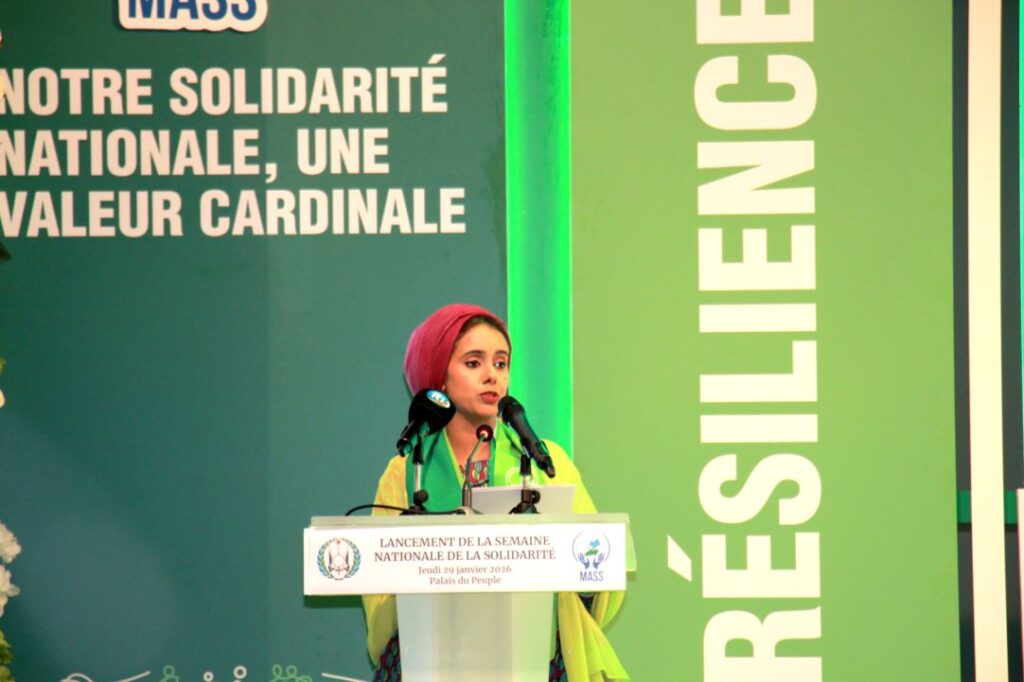
A highlight of the ceremony was the series of official speeches, which lent it a human dimension. First to speak was the Minister of Social Affairs and Solidarity, Ms. Ouloufa Ismail Abdo, who reminded the audience that behind every statistic lies a human story, a face, a dignity to be preserved. “Between 2018 and 2026, more than 93,000 households, representing nearly 525,000 citizens, benefited from the social protection programs deployed nationwide,” she emphasized. These figures reflect the scale and consistency of the State’s commitment to the most vulnerable. The interior regions were not forgotten. Addressing the President of the Republic, the First Lady, and the numerous other dignitaries present, the Minister highlighted the significant coverage provided in Tadjourah, Dikhil, Ali-Sabieh, Obock, and Arta. “This initiative has empowered citizens through the promotion of Rural Savings and Credit Unions, the development of mutual aid groups, the training of nearly 3,000 young people and women, and the construction of over 200 basic social infrastructure projects designed to sustainably improve living conditions,” she stated. These sustained efforts have yielded tangible results, reflecting a significant reduction in social and economic inequalities.
“Extreme poverty declined between 2017 and 2025, while the Gini index fell from 0.42 to 0.38,” she specified.
Minister Ouloufa Ismail Abdo also paid a heartfelt tribute to the unwavering commitment of the First Lady, Mrs. Kadra Mahamoud Haïd, to defending the most vulnerable. Addressing the Head of State, she then declared with emotion: “You are not only a leader to us, but a father, a role model who educates us every day, even better, for a better Djibouti,” remarks that were met with a prolonged round of applause from the audience.
In his address, the President of the Republic, His Excellency Mr. Guelleh, emphasized that National Solidarity Week is first and foremost a week of immersion in reality. This approach allows public action to directly confront citizens’ expectations and adjust its responses accordingly. The Head of State then stressed the essential distinction between assistance and dependency, emphasizing that solidarity must be a lever for empowerment, not a source of lasting dependence. President Guelleh also highlighted the central role of women in social development, affirming that investing in women is investing in the future of the nation.
In launching the 2026 National Solidarity Week, the President of the Republic, His Excellency Mr. Ismail Omar Guelleh, emphasized that a nation’s greatness is measured by the attention it gives to its most vulnerable members. This lesson in humanism and collective responsibility will guide the solidarity caravan, led by the Minister of Social Affairs and Solidarity, which will spend over a week traversing mountains and valleys, covering the entire national territory and reaching even the most remote areas, with the aim of leaving no citizen behind and making solidarity a lived reality, as close as possible to the people.